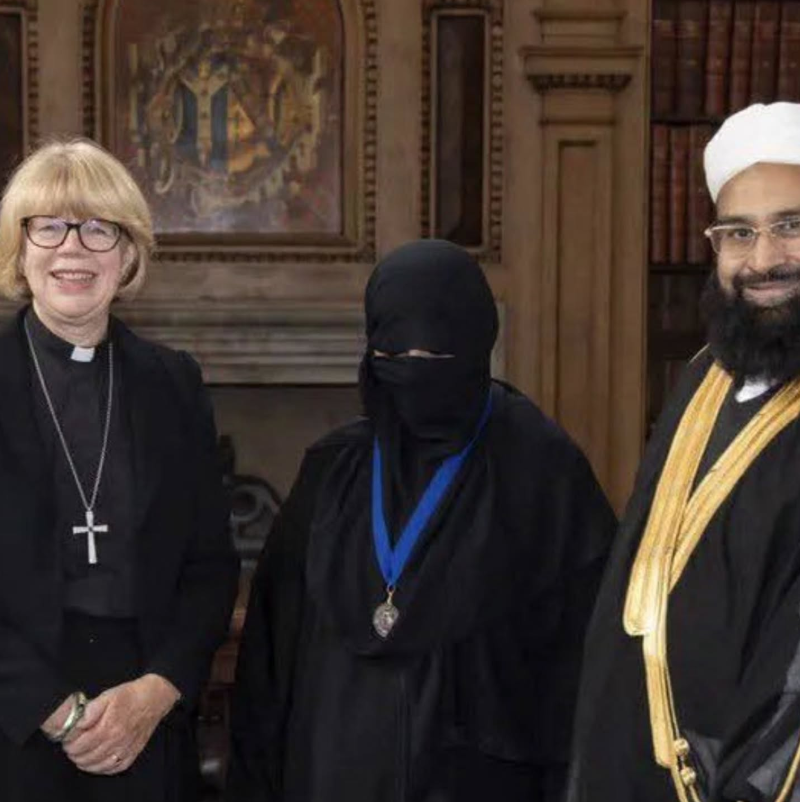
A photo from 11 September 2026, not from the Middle Ages.
At Lambeth Palace in London, the Archbishop of Canterbury, Sarah Mullally, the first woman to hold the post, gives the Hubert Walter Award for Reconciliation and Interfaith Cooperation to a Pakistani cleric, Tahir Mehmood Ashrafi, for his support of religious minorities in Pakistan. Between the two of them stands a woman covered head to toe in black, face behind a niqab, only her eyes visible: his wife.
To be clear: she received no award. The prize was his, and only his. Some people looking at the pictures think the medal passed through her hands (in some photos she seems to wear it, in others he does) because he wouldn’t take it from a woman; nobody has confirmed that, and Lambeth never explained how the hand-over was arranged. His side says the niqab is her own choice.
What is confirmed is the rest: nobody says who she is. Not the press, not Lambeth Palace, not the official story of the day. At a ceremony about tolerance and respect, the only woman standing between the two leaders has no name, no voice and no face on the record. We know almost nothing about her, so I can’t say what she wanted or felt. But I can see how she was (not) seen.
Six days later, on 17 September, Lambeth Palace withdrew the award. Not because of the photo: because Ashrafi’s 2007 comments had “come to light”, when, in protest at Salman Rushdie’s knighthood, he offered Osama bin Laden the title of “Sword of God”.
Tolerance, respect and peace, said the medal. Apparently, not for everybody.